Showing posts with label Travelogs - UAE. Show all posts

Tuesday, March 1, 2011

Heritage and Diving Village, Shindagha Area, Dubai

After two previous failed attempts to visit the Heritage and Diving Village in Dubai, we finally made it there this weekend. Located next to Sheikh Saeed's House, there is plenty of parking (free on Friday) and entrance is free but sadly although it does open at 16:30 on Fridays, even by 17:30 it seemed most of the people working there had decided not to turn up for work so it was all a little deserted.

Of those who had come to showcase Emirati heritage was one burqa-clad lady making pancakes over a small stove. With minimal English but great hospitality, she made us each a pancake - 3 pancakes for just Dhs 10. I wasn't 100% convinced of the hygiene of her 'kitchen' but figured eating a pancake burning hot from the oven should be safe...and it was delicious. A word of caution to any tourist though: never photograph a local lady without first asking her permission or you could land yourself in hot water. Luckily, she was more than happy to be photographed. It's actually very rare nowadays to see anyone wearing the burqa (gold coloured mask to cover the face) and you will generally only see it on old ladies in the predominantly local areas. Younger women tend to not cover their face and when they do they are covered with the same thin material as their headscarf - I'm sure it's a lot more comfortable and cooler than the hard burqa mask.


The village has replica stone houses and areesh houses (areesh is made from plaited palm fronds) which I think would normally have housed little shops but these were all locked up. There was an area with a sign 'Bedouin Life' but nobody was there demonstrating the bedouin traditions, perhaps that part is only open at night. Performances of some kind must be staged at certain times because there was a large open area with rows of chairs but there was nobody to ask for information. For children, there were 2 ponies for trotting about on and unlike in many parts of the world where you can find the animals in a very sorry state, these both looked very healthy and well-fed.


Next to the Heritage Village, we entered the Diving Village (also free entrance) but this was even more deserted. When it's in operation I believe that there would be men demonstrating how the pearl industry worked as well as museum-style displays of photos and information on the hazards this profession suffered. According to the displays at the Dubai Museum, some divers could hold their breath for up to 5 minutes while they braved jellyfish and dangerous seas searching for the perfect pearls.


All along the front, looking out on the Creek and the passing dhows (these wooden boats are still a key means of transporting goods between India and Dubai), are a multitude of restaurants that we never knew existed. Although the number of tables and chairs gave the appearance that they were very much aimed at busloads of tourists, on this Friday afternoon there seemed to be a lot of Arab nationals as opposed to tourists so the food is presumably of a good standard. Numerous people seemed to be eating from small table-top BBQs with skewers of meat grilling over the coals; it looked very authentic and interesting. We will need to plan an evening or lunch-time visit next time so we can sample some of the food.


We ended our visit at the house of Obaid Al Thani which is very similar in style to Sheikh Saeed's House but didn't hold the same appeal for us. It is primarily a religious museum with rooms devoted to quotes from the Holy Quran on subjects such as The Creation of the Universe, The Creation of Man etc. Again, entrance was free to the house. The central courtyard was dominated by a stage and seating where we presumed religious lectures or debates must be held. There were a few men working there who I believe would have been happy to explain any questions we might have had about Islam so for anyone wanting to gain a deeper understanding of the religious traditions of the UAE, this could be a good place to start.


During the week the villages open at 10, although whether that means all the shops and displays will be open at that time is another matter! Maybe next time we'll try on a Saturday and see if we have better luck.

Tuesday, February 22, 2011

Danat Jebel Dhanna Resort, Abu Dhabi

A pre-baby holiday, we were advised, is a must; since I didn't want to fly anywhere and we had been wanting to visit the Danat Jebel Dhanna Resort (owned by the National Corporation for Tourism and Hotels) for years, we decided this would be the perfect opportunity. Jebel Dhanna lies south of Abu Dhabi, about a 3 hour drive from Dubai. To make a 6 hour round-trip worthwhile we had always thought a minimum of 3 nights would be needed, which explains why we'd never been. Unbeknown to us at the time of booking our mini-holiday, a public holiday was declared on the day we had planned to drive down to the hotel which meant that we gained an extra half day of chill-out time and had a full 4 days away!

The Journey

The hotel's website is sadly lacking a proper map, although the directions turned out to be simple so there is no excuse for not having those directions on the site. They had a link to Google Maps which showed the hotel as lying right in the centre of Abu Dhabi next to the Marina Mall - about 200 km away from the actual hotel!

Driving from Dubai, you take Sheikh Zayed Road and turn off right when you see signs to Tarif (Danat Jebel Dhanna Resort is also signposted). This right turn is actually a fly-over that takes you left so that you go onto a bridge over SZR. You then stay on that road all the time, following signs for Al Sila until you see the hotel signs. A word of warning: there are no street lights and it is only 2 lanes in each direction with a lot of heavy vehicles so I can imagine it would be a bit less pleasant driving that road at night. We had no hold ups as all the trucks amazingly stayed in the right-hand lane and we just had to pull into that lane from time to time to let the usual crazy Abu Dhabi head-light-flashing speedster past.


The total journey from Jebel Ali to the hotel was just over 300 kms, so it took about 3.5 hours with a couple of stops. There is a petrol station after you turn off towards Tarif (100 kms from Jebel Ali) and then they have them about every 80 kms or so along the route. Coming back, the first petrol station we came to was 145kms from the hotel although we had passed a couple on the other side of the road before that. The route is not an interesting one and there is absolutely nothing of interest to see along the way, the most exciting thing we saw was a couple of camels being transported in the back of a pick-up truck.

The Hotel

Although not the most attractively-designed hotel (see later on the Desert Islands Resort, it seems aesthetics aren't too much of a consideration in this area of the UAE), the grounds of the Danat Jebel Dhanna Resort more than made up for the uninspiring exterior.


The beach at the Danat Resort is fantastic. Just to see a stretch of coastline that hasn't been destroyed with offshore developments, such as The Palm, was amazing. In the afternoon with the tide out, we saw people walking out to sea for a good few hundred metres with the water only up to their knees - we would have done it ourselves but the sea was a bit too cold for our liking! Beautiful turquoise water, white sand and little thatched umbrellas and loungers all along the front. It is possible to walk quite a way along the beach past the neighbouring hotel (the Dhafra Beach Hotel, which seemed completely empty) and that was the extent of our daily exercise during our 4 days there.


The hotel has one pool plus a small children's pool - complete with slide. The water was a lovely 30 degrees and had a swim-up bar where you could sit in the water on underwater bar stools. As it is February and the hotel is quite exposed, there was quite a fresh breeze blowing all the time so I have to admit the closest I got to going in the pool was dipping my foot in since I didn't like the idea of getting out all wet and being hit by a cold wind. All around the pool were grassy areas as well as a children's play area and various sports facilities: tennis courts, beach volleyball pitch, beach football pitch and basketball. No excuse for getting bored!


We were initially checked into a twin-bedded room. Our last holiday before we become sleep-deprived and we were given separate beds, what is that all about?! We headed off to the pool for some lunch while they got us a king-sized bedroom ready. Both of the rooms (twin and king) were a similar generous size with great views out onto the gardens and beach. The bathroom didn't have a separate bath and shower but I found the bath was the perfect size for me to lay back and doze off in every afternoon. There was a DVD player but we had forgotten to bring any DVDs and the hotel charged Dhs 50 to rent 2 DVDs! I think that is what you would call a total rip-off.


The only disappointing thing in the room was the mattress - a cheap foam one that was fairly rock hard, not the high-end sprung mattress you would expect to find in a 5 star hotel. I requested some sort of padding to soften the mattress and an even lower-quality camping foam mattress was laid on top leaving me a good few inches higher than Simon in bed! From one extreme to the other, this one was so soft that I sunk into it and the next morning the dip I had created was still visible half an hour after I got out of bed. For our last night, I decided the harder mattress was the lesser of two evils.


The Food

Danat Jebel Dhanna Resort is not where you would come for a gastronomic experience. It offers an all-day dining buffet restaurant, a lobby lounge, a pool menu and an Italian restaurant. We got the distinct impression that most of the tourists (predominantly German and Scandinavian it seemed) were on all-inclusive packages since they seemed to eat all their meals at the buffet. The pool, lobby lounge and room service menus all offered exactly the same food and whilst the standard of food wasn't bad, the choice was very limited and after 3 lunches and dinners I had eaten everything that interested me.

The breakfast was excellent, although no pork is served and chicken sausages and veal bacon just don't cut it as far as I'm concerned. The offering was fairly standard of a hotel in the UAE with fresh fruits, tinned fruits, yoghurts, cereals, salad items, smoked fish, eggs, baked beans, grilled tomatoes, porridge, pancakes, waffles and pastries. It's recommended to "breakfast like a king" and I would say I successfully ticked that box every day!

Lunch at the pool consisted of sandwiches (I tried a panini but it was the grilled bread and cold cheese and tomato story again), satay (my no pepper request didn't get through though and the satay was coated in black pepper), noodles (which were tasty but a bit more chilli-infused than expected) and fajitas (served more like a shawarma than the traditional fajita style). All entirely edible and acceptable but nothing that had any 'wow factor'. There were also no tables and chairs set up so we had to eat sitting on our loungers which I generally find a less than ideal way to eat a meal.


Dinner is what gave us the most eyebrow-raising moments though. We saw that the Italian restaurant was closed on Saturdays so decided to eat there the first 2 nights. Unfortunately we weren't warned that the restaurant was tiny and that bookings were essential. The restaurant is called Zaitoun (olive in Arabic) which would make sense if it was an Arabic or Meditteranean restaurant, the menu was 100% Italian though so Olivio would really be a more appropriate name. My impression was that it maybe used to be an Arabic restaurant and the hotel then decided Italian would suit its guests better. The decor was certainly Arabic with low tables and chairs all around the fringes and only about 5 normal dining tables in the middle. The last thing I want to do when I'm eating a 'fine dining' meal is sit down to eat it at a coffee table!

When we got to Zaitoun on Thursday evening we were told that it was fully booked and only the low tables were available but since all the people eating at those tables looked very uncomfortable, we didn't want to chance it. We asked if anyone was about to leave and we could wait but the waiter said everyone had just started. On the way out we saw the manager and told him we thought the design of the restaurant was appalling; he didn't seem too bothered about it but did say that a request for changing the low tables for high tables was sitting with the management. We had a look at the buffet but, not being in the best of moods, I didn't like the look of anything as the chefs seemed to have gone to town with the black pepper. Five minutes after leaving Zaitoun, we saw a group who had been eating there crossing the lobby - a fantastic waitress in the Lobby Lounge checked for us and confirmed there was now a free table! When we returned to the restaurant, there was no apology for telling us the group had just started when they were clearly just finishing and it actually seemed like the waiter and manager didn't even remember us!

The second night provided even more shocks when we heard a group of 4 ladies next to us complaining that they'd been waiting over 1 hour for their meal. We expected something elaborate to come out of the kitchen for them but it was just pizzas...and they were stone cold. Thankfully our experience of the food was very good on both occasions. Simon stuck to Italian favourites of beef carpaccio and pasta the first night with caprese salad and lasagne the second one. I stayed clear of the wheat and had only salmon the first night (after all the fiasco we didn't sit down to eat until 9pm) but made up for it with calamari, veal escalopes and chocolate fondant the next night. Sadly the service wasn't on a par with the food, although it could hardly be expected when the manager seemed to have no interest whatsoever.


There was a great camaraderie amongst the diners in Zaitoun on the Friday night when a group of European hotel guests who were eating in the private dining room of the restaurant decided they were sick of their crying child. Did they take him up to bed? No, they put him outside their dining room and closed the door so that the rest of us could listen to him wailing instead! Everyone started laughing at such an unbelievable thing happening and one lady asked the waiter to go and tell the child's parents that they would have to take him back in with them. The father didn't look amused at having his dinner disturbed!

We did eat at the buffet on our last night and it actually wasn't bad. The salads were varied, there was a choice of mains including fish, chicken, lamb, beef plus a roast lamb leg and there were pancakes and other cakes for dessert. However, the price was extremely high compared to what you would pay in Dubai: Dhs 190 inclusive of 1 soft drink! The food prices throughout the hotel were sky high since everything quoted on the menu then had 16% tax and service added - it has been about 10 years since Dubai started to print the actual prices so that you know exactly what you are paying for an item and I can't understand why this hasn't filtered through to the rest of the UAE. A prime example was the steak at Zaitoun - Dhs 200 plus 16%...I nearly fell off my chair! Beer was Dhs 32 plus 16% and the measure wasn't even a pint but somewhere a bit less.

The Area

On our second day we headed out to see if there were any other restaurants around that might not be so pricey and to have a bit of variety. In a word...NO. We thought Jebel Dhanna was a small town but when we reached a security gate with soldiers carrying machine guns and a big 'Criticial National Infrastructure' sign we realised that the area is a major oil zone. From within the resort this wasn't obvious until the last day which had no haze and we could see about 30 kms down the coast to a huge docking platform for oil tanker ships to pick up oil / gas - the pristine water at the beach certainly gave no hint we were in the middle of an oil field.

The next day we drove over to the main town of Ruwais, hoping this might offer something a little bit cultural. It didn't. The complex has been built purely to house those people working in the area's oil industry and consisted of what seemed like hundreds of villas, townhouses and apartment buildings. We found the central market which consisted of a supermarket (with the grumpiest cashier I've ever come across) as well as a shop selling cassette tapes - I didn't know cassettes were even still getting made! A posting to Ruwais would certainly be classified as a hard-ship posting anyway.

I didn't take any photos since there have been a number of cases reported in the papers recently of tourists in Abu Dhabi being arrested for taking photos where they aren't supposed to! They had a genuine excuse, as far as I could read, since in other countries taking photos of palaces is not a criminal offence - but apparently it is in Abu Dhabi so be warned! With armed guards on lookout points all around the area I had a sneaking suspicion that photography would definitely not be allowed here.

There is a petrol station in Ruwais so if you don't have enough fuel to make it the 145 kms to the next one, fuel up here after you leave the hotel.

Sir Bani Yas Island


Visiting Sir Bani Yas Island was my main motivation for wanting to come down to Jebel Dhanna. Sir Bani Yas is a nature reserve established by the late Sheikh Zayed and until recently, outside the Royal Family, only guests of the Danat resort could get access to visit the island. There is now an Anantara hotel, Desert Islands Resort, on the island itself but guests of the Danat resort are still allowed to visit at a cost of Dhs 250 per person.


We were escorted to the Sir Bani Yas ferry terminal, 16 kms from the hotel, where we boarded a speed boat to make the 20 minute crossing to Sir Bani Yas (on the way back we were in a standard passenger ferry-style craft). Once on the island, our group of 6 was met by a Scottish guide who took us on our tour in an African safari-style open-sided jeep. We had expected quite a small island but discovered that it is actually 87 km square - about the same size as Barbados. The island is home to giraffes, sand and mountain gazelles, eland, red deer, oryx, other types of antelope / deer, ostriches, hyenas and cheetahs. With the exception of the ostriches and hyenas, we managed to see all the animal species on the reserve. Although not native to Arabia, the cheetahs are used as a natural control on the gazelle population which numbers over 12,000.


Although a nature reserve, Sir Bani Yas is certainly not an eco-friendly island. Fresh water is piped over to the island from the desalination plant on the mainland and is used to irrigate the entire island which would otherwise be completely barren. I can't even begin to imagine the amount of water that must be used for all the trees, shrubs and grass planted to feed the animals and give them shade - plus for the thousands of animals to drink. The tour lasted about 1.5 hours with the cheetahs and giraffes definitely being the highlights for me.


We hopped on the Desert Islands Resort shuttle bus to have lunch at the hotel before heading back to our car for the drive home to Dubai. We expected the hotel to be a few minutes away from the arrival dock but it was a 20 minute drive to another part of the island and as the resort came into view we were really disappointed to see quite an eyesore. On a nature reserve we would have expected a very low rise development built to blend in but this was 4 storeys high with green roof tiles! Certainly cheaper to build but a real shame in this day and age for any architect to design such a building.


Despite its exterior, the interior of the resort was a very traditional Arabian style and the pool area outside was gorgeous. All the staff we met were excellent and a step above those at the Danat resort, as would be expected from an international hotel chain of this calibre. The one thing that I would have been really upset about if I was a guest at the Desert Islands Resort was the beach. The resort has been built on reclaimed land which we couldn't understand considering the vast empty spaces of the island and this meant that their beach could not compare to the beautiful natural beach at the Danat Resort. We were pleasantly surprised to find the food prices at the Desert Islands were cheaper than at the Danat though and I succumbed to temptation and had a delicious steak sandwich.


Conclusion

Although we had a really relaxing 4 days, Simon and I both felt that from Dubai it would be better to head to Al Aqah on the East Coast for a long weekend than drive all the way down to Jebel Dhanna. Al Aqah has 4 or 5 hotels now with each one offering 2 or 3 restaurants so there is much more choice for eating out, plus the food prices are cheaper. At just a 2-2.5 hour drive through the mountains it also offers a far more interesting and quicker journey. All the animals on Sir Bani Yas can be found at the Arabian Wildlife Centre on the Sharjah-Dhaid Road and a trip to the AWC is only 1 hour from Dubai, or can be made en-route to Al Aqah. You don't get driven around in a safari jeep since it's more of an open-air zoo, but to drive 3 hours plus the boat transfer doesn't really add up to a good idea in my mind if the whole reason to go to Jebel Dhanna would be to visit Sir Bani Yas.

For people living in Abu Dhabi, Jebel Dhanna is only 2 hours away and the pristine beach would make a weekend break worthwhile. I would definitely choose the Danat Resort over the Desert Islands Resort though since the beach is so much better and the price extremely lower (Dhs 700 B&B per night versus Dhs 1,350 B&B per night). To get to the AWC from Abu Dhabi would be a long drive and since there is nothing similar on offer in Abu Dhabi, visiting Sir Bani Yas Island would make sense - although Al Ain Zoo also has similar animals to marvel at and is closer.

I've waited years to go to Jebel Dhanna and am glad that we finally made the trip, despite the few hiccups we encountered. We don't regret having gone since we had a lovely few days away, but we won't be returning since it just doesn't trump other locations within the UAE for the perfect weekend break.

Sunday, December 12, 2010

At The Top - The World's Tallest Tower

At 828 metres, the Burj Khalifa is currently the world's tallest tower - how soon it will be surpassed remains to be seen. On the 124th floor they have created an observation deck so that visitors can see Dubai from a previously impossible perspective. Although Simon's mum is not keen on heights, she felt that she shouldn't miss the opportunity to experience this new Dubai icon. Book online through the Burj's website and a ticket will only cost you Dhs 100 (Dhs 75 for children) but buy it on the day at the ticketing office and you will pay four times the price - a steep (no pun intended) Dhs 400. The only problem with booking online is that you can book 48 hours to 30 days ahead - not on the day you want to go up. With Dubai's notorious dusty, hazy days this means that you could find minimal visibility on the day you've booked for - and I believe that tickets are non-refundable. Luckily on our visit there wasn't too much haze in the sky.


Access to At The Top is through Dubai Mall, with a 65 metre travelator (flat escalator) transporting you through a tunnel from one building to the other. Very futuristic. We found the whole process very well-organised and smooth since each half hour time slot has a fixed number of tickets available and this avoids any huge queues or over-crowding. The only time we had to queue was for the lifts but even then a video of the construction of the Burj is shown to keep you distracted. You would expect that a lift ride up 124 floors would take at least 5 minutes but the Burj has unbelievably fast lifts that get you up there in just 60 seconds! I was worried I'd feel a bit sick going so fast, like one of those fairground rides that shoot you up at high speed, but I felt nothing at all except my ears pop at about 30 floors. I did feel very sorry for the lift attendants who have to spend the entire day inside that black box shooting up and down with group after group of visitors - the ones we had were very cheerful though so maybe they rotate positions with other 'ground staff'.


The two most striking things when you look at Dubai from up high (even from the 50th floor of Emirates Towers) is the amount of empty space and the barrenness. With so much spare land, why have all these destructive artificial palms and islands been created? Very sad. Driving around gives you the impression that Dubai is really green but put that into perspective from the sky and you see that Dubai is brown, brown, brown. On a clear day you can apparently see up to 95km but we could just about see to the Burj Al Arab Hotel which is no more than 30km away (I think). It seems that going up to watch the sunset is very popular, but as the sun sets in the direction of Burj Al Arab then this does make taking photos a bit tricky. The main observation floor is enclosed but there is an outside balcony - the sides are enclosed with glass so there's no chance of falling over! I liked the fact that the glass wall around the balcony had gaps in the glass so that you could take photos without any reflections although Simon did question the safety if someone accidently dropped something over...you wouldn't want anything landing on your head that had just fallen 124 floors!


I would certainly recommend At The Top to anyone who hasn't been up before. Maybe in 5 years I'll go up again to take photos and compare the changes but I wouldn't go again in the short term since it's really a case of 'been there, seen that'. There is a small gift shop on the observation floor and a much bigger one downstairs as you leave but I wanted to get a fridge magnet, which is unfortunately not something they are selling yet - a tacky gold bag I could have easily got, but not a simple magnet.

Saturday, December 4, 2010

Chilling Out at Meridien Mina Siyahi

With my mother-in-law, Kath, staying, it was decided that a day relaxing at a beach resort would be a great change from our apartment building's large but freezing swimming pool. 'Buy 1 get 1 free' voucher from The Entertainer in hand (Dhs 175 for both of us), we set off for our day of sun, sea and sand at the Meridien Mina Siyahi. The voucher was only valid Sunday-Wednesday which meant that Simon couldn't come, but I made sure to call him once we were lying on our loungers looking out to sea just so he wouldn't feel left out!


The Meridien has 2 swimming pools as well as a long beach, sadly one of the pools seems to have been permanently barricaded off since it lies within the Barasti Bar area. I think you can also use the pool at the adjoining sister property, The Westin, but we didn't investigate that. We spent the morning on the beach and the afternoon by the pool - although we wished we'd stayed down on the sand since the Meridien has a serious problem with crows around the pool. Crows are scavengers and they feed on rubbish and carrion...they are a very bad sign that there is a lack of cleanliness and it seems they are becoming more and more common in Dubai. These crows were not just huge ugly vicious-looking things, they weren't afraid of humans at all and one actually landed on Kath's head!! Apparently the Burj Al Arab has resident falcons that fly around the hotel to keep other birds away - the Meridien needs to do something like that because a line up of 10 black crows along the loungers next to me was not conducive to me relaxing in the slightest. One positive point was that the pool was heated to the perfect temperature for me and I was able to get in without it taking my breath away.


The beach along the front of the two resorts is huge and we saw hundreds of fish of varying sizes as we walked along the shore. As with all the Dubai coast, the natural beach has been lost and so it is all trucked-in sand which then creates a much harder surface - luckily the gradient drop down to the sea is not like the one we found on the public beach near Paul's though (earlier review)! I found the lounger mattresses quite thin and uncomfortable but that didn't stop me from being able to drop off to sleep for a good hour. Lying on the beach you look out onto the Palm Jumeirah and the Atlantis Hotel, gone are the days when a day on the beach meant seeing nothing but sea all the way to the horizon. We could have had an active day of banana boating, kayaking or water-skiing but that all sounded like too much hard work so we watched other people out on the water instead.


The beachside menu is the same as the poolside menu, and it was exactly the same menu as when I was last at the hotel...nine months ago. A revamp of the menu would certainly not go amiss. I felt sorry for the hotel guests because there wasn't a huge variety of options and if I was staying there for a week I wouldn't be impressed. Also, the prices were very high for a pool menu - Dhs 115 for seabass. Are they mad?? Kath ordered the mezze platter but this only came with Arabic bread and we had to pay extra for vegetable sticks to dip in the hummous, moutaboul and tabbouleh. I had grilled salmon served with sweet potato puree and a side salad, all very nice although the salad dressing was a little too strong on the mustard for my taste. I would have preferred a salad but the choice was limited and nothing appealed. Although it was a good lunch, I have had much better (and cheaper) at other hotels such as the Hilton Jumeirah Beach and the Meridien Al Aqah.

Simon and I are planning to spend Boxing Day at the Meridien Mina Siyahi because it is great value to feel like you're on holiday for the day, the pool is lovely and the sea is great. We'll just make sure to not sit on the pool loungers and we'll try to find somewhere else to eat our lunch.

Thursday, November 25, 2010

Dubai Museum and Bur Dubai Souk

The Dubai Museum has existed for decades but its tiny size meant that it wasn't much of a tourist draw. About 10 years ago a major renovation and extension of the museum was done and it is now really interesting and receives busloads of tourists every day. Located in the Al Fahidi Fort, one of Dubai's original fortifications and one of the few buildings in the UAE that is over 100 years old, it is to be found near to the Dubai Creek and the historic areas of Bastakiya and the Bur Dubai Souk. Bur Dubai is the oldest area of Dubai, located on the opposite bank of the Dubai Creek from Deira. Parking in the area can be a struggle but we managed to find a space in one of the private car parks that charge a rip-off price of Dhs 10 per hour...needs must though.


The Fort was built using the traditional coral and mud materials of its time; it has since been renovated but, as with Sheikh Saeed's House, the renovation has used cement so it is not quite the genuine restoration you would find in Europe. Nevertheless, from a distance the walls and watchtowers look the same as they do in the old photos of the area and if you can ignore the traffic and the neon lights of the buildings around about then you can imagine yourself back in the times where the people of Dubai had to keep a look out for marauding bandits from other Bedouin tribes.


Entrance to the museum is only Dhs 3 and you enter into a sandy courtyard where you will find examples of the various boats used over time (for transport, fishing, pearl-diving and more), numerous cannons as well as a reconstruction of a traditional Areesh house. Most people lived in homes made from palm fronds (areesh), not in solid mud/coral houses and this example allows you to experience what that would have been like. There is a windtower which trapped any breeze to naturally cool the house as well as an outside kitchen (so the heat of cooking didn't heat up the house) and an outside sleeping platform for during the summer months. In the past it was possible to climb up onto the ramparts of the fort, but this is now closed, however 2 of the rooms in the fort walls have been made into exhibit rooms showing the various weapons of the past, traditional musical instruments and other artifacts.


The courtyard used to be the sum total of the museum but the extension takes you underground to a surprisingly large air-conditioned series of rooms. A circular ramp leads you down from the courtyard and past a number of taxidermied birds that have seen better days and could really do to be replaced as they appeared rather moth-eaten and forlorn. The first room shows a video of Dubai from the early years (pre-1950s) through to the 2000s. An excellent introduction that reminds you exactly how far Dubai has come in such a short space of time, it could do with updating though since it only goes up to the early 2000s and a lot has been added to the city in the past 5 years.


Other rooms in the museum include one showing traditional life with life-sized mannequins within the settings of the carpenter's shop, the textile shop, the ironmonger's, the grocer's, the Quran school and more. With clear explanations next to each exhibit of exactly what is being shown and why things were done in that way, it is very informative without being boring. A room dedicated to the desert at night showcases the local animals (taxidermied, not live ones) but, as with the birds at the entrance, they could really do with replacing since they are starting to look a little bit threadbare. The room dedicated to the sea was very interesting as you learned how dhows are constructed and about the dangers of the pearl-diving industry - some divers could hold their breathe for up to 4 minutes and they risked jelly-fish stings and more in their pursuit of the tiny little white pearls. The most exciting exhibit for children would probably be the skeletons unearthed from ancient burial sites; archaeologists found evidence (including these skeletons) in Jumeirah and other areas of the UAE of settlements dating from approximately 3,000 BC. Prior to leaving the museum, there is of course a small shop selling tacky memorabilia as well as the newest extension showcasing archaeological finds including 5,000-year old arrowheads, pots, jewellery and more.


From the museum we walked down to Bur Dubai Souk with the intention of finding a kaftan for my mother-on-law and as we entered a very narrow passage you would have been forgiven for thinking you had been transported to India. The Hindu temple is located in this small back alley and on both sides of the lane were tiny shops selling the traditional offerings of chains of bright orange flowers, milk and sweets. We arrived just as people were leaving the temple so it was thronged and full of life. Free food of rice and vegetables was being offered not only to all the worshippers but to us as well, whilst it smelt very tasty I didn't want to risk an upset stomach and also didn't feel it would be right to take food that I'd not done anything to deserve.


Exiting the busy temple street into the souk was like entering a ghost town. All the shops were closed (perhaps because all the shop staff were at the temple) and there was barely a soul about. Luckily as we continued our walk through the deserted souk we entered a section that was open for business and we then had to withstand every seller calling us into his shop and fake watch and bag sellers following us down the street asking us to go with them to look at their illegal products. At the end of all that, nowhere was selling kaftans but we did manage to buy some pashminas at a third of the price that you can buy one in a shopping mall. All was not lost though and we drove to a street where locals shop (as opposed to tourists) and Kath was able to get her kaftan for just Dhs 50 - if you're looking for the street, it is where Lobo's Tailor is found.

A great afternoon of the ancient, the old and the modern thrust and bustle of market life. Visitors to Dubai who only visit the shiny mega-malls and five-star hotels are sadly missing out on a genuine opportunity to experience the real life of Dubai up close and personal that you really only get by going into the thick of things in Bur Dubai and Deira.

Sunday, September 26, 2010

Discovering the Old Dubai

Dubai's reputation is that of a shiny new city full of architectural wonders, gold, luxury hotels and shopping malls. That is only one face though and Dubai actually has a lot of history to offer residents and visitors. History here only takes you back about 100 years though, not the hundreds or even thousands of years of history you will find in Europe, the Levant and much of the rest of the world. We started our delve into Dubai's past in the area of Shindagha which lies at the mouth of the Dubai Creek.

In the 1940s, most Dubai residents lived along the Creek in either Shindagha or Bur Dubai. The world-famous Jumeirah was home to just a few small fishing settlements. At that time Dubai was ruled by the current Sheikh Mohammed's grandfather, Sheikh Saeed. It was Sheikh Saeed's House that we went to visit - at just Dhs 2 (less than 50p) to get in it's certainly not a bank-breaker. The majority of people in the 1940s lived in 'areesh' houses which were made of palm fronds and which of course no longer exist. However, there were some solid houses made of coral and mud and Sheikh Saeed's House and the surrounding buildings were amongst them. All houses in those days (mud and areesh) were cooled by a windtower which was designed to catch the wind from whichever direction it was blowing and channel it down into the house.


Buildings were not made to last (sadly that trend seems to have been followed with all the recent 'freehold' developments too) and what actually stands in the Shindagha area is a replica of the buildings that were once there. The house consists of a central courtyard with numerous small rooms leading off it and upstairs except for a large sitting room ('majlis'), the roof is open with great views onto the Creek. The door to each room is tiny and even I had to duck to go through - a security tactic since it's easier to defend against someone who has to enter the room head first. Each room within the house exhibits different aspects of life in the 1940s and at the entrance to the house there is a room with photos of what the area looked like in the 1990s before it was redeveloped. What was left of the original house had to be knocked down as the photos show clearly that repair would have been impossible since walls had crumbled and collapsed.


Many of the exhibits are old photos that provide a fascinating insight into what Dubai was like. It is hard to imagine how quickly a small settlement of uneducated tribesmen could rise up to be the megacity we see today. Sheikh Saeed looks like a druid or wizard with his long white beard, long white hair and tall, slender frame. Photos also include Sheikh Mohammed's father, Sheikh Rashid who is remembered as the Father of Dubai since it was his vision that laid the foundations for Dubai's current wealth and prosperity, as well as photos of Sheikh Mohammed and his brothers as children. Shindagha now backs onto an 8 lane motorway and Port Rashid but the photos show that previously the area lay along a pure white beach directly on the sea. Other exhibits include old maps of the area, the various currencies and coins used here for the past 100 years and models of dhows and pearl fishing boats.


We had planned to visit the whole area which includes other rebuilt historic houses but unfortunately the 40 degree heat forced our retreat. The rooms in Sheikh Saeed's House, although fitted with AC, aren't linked to each other so it's necessary to come outside into the courtyard each time and after over an hour of that we were just a little drained. Presumably in the past the rooms were linked to a windtower above but having them open to the air now wouldn't do the exhibits any good! A fascinating place to visit, but better in the cooler months. As Arnie would say, "We'll be back".

Sunday, September 12, 2010

Ajman - Worth a short visit

It is easy to spend your weekend going to shopping malls, out for a meal with friends or simply sitting at home watching TV. However, there is a lot out there to do and see so Simon and I have decided to try and do something a bit more interesting at least two weekends a month. We started our quest yesterday with a trip up to Ajman; the smallest of the 7 emirates that make up the UAE. I've lived in the UAE almost 30 years and had never been there, had I been missing something fantastic all these years? Unfortunately not, although there were a couple of interesting things that made the trip worthwhile.


Ajman is only 40 minutes north of Dubai...at the weekend that is - with working week traffic it's more like 2 hours. The main thing that struck us with Ajman is that it is all apartment blocks, we hardly saw any villas and those we did see were of the 'falling apart style' similar to what you'll find in the local area of Satwa behind the Fairmont Hotel. There are a lot of attractive new tower blocks but from what the newspapers say, a lot of these (sold as 'freehold') have no power, water or sewage since the Ajman authorities lack the infrastructure to provide it. The other thing to strike us was that it seemed to be almost all residential; we didn't see any area that looked like a business district. This makes sense since a lot of people who couldn't afford to live in Dubai and couldn't find accommodation in Sharjah moved to Ajman since it was cheaper. What the builders of all the towers we saw had clearly forgotten to build, though, was car parking - there were cars parked on every available scrap of sand and I wouldn't have liked to be the owner of a car stuck in the middle with no way out!


The Dubai Explorer had said there was a good souk and a museum but we never found the souk since there were no signs for one at all. Does it really exist? We didn't see any old cultural areas at all except for the museum which apparently dates back to about 1775. The museum looked like it would have been quite interesting but sadly it was closed for Eid. We couldn't help laughing at the sign outside, what constitutes an official morning and an unofficial morning? Clearly, it means days of official mourning (basically a public holiday is declared when a member of the ruling family dies) but a tourist could misconstrue it!


Close to the museum we discovered the Ajman Kempinski Hotel. I had looked at the hotel a few months ago with a view to going there for the weekend but the Trip Advisor reviews were all terrible and said it was dated with a dirty beach and right next to the port. I don't know where those visitors had been staying because we were really impressed with the hotel and will definitely plan a weekend there at some point. Maybe they've had a recent refurb, but we found all the interiors in excellent condition and tastefully done and the beach...wow...the best beach in the UAE I would say. Seriously. Dubai has sadly lost all its beaches due to the 'wonderful' palm projects so most beaches now consist of sand that is brought in by truck and this replenished sand becomes like mud when it mixes with the seawater. Ras Al Khaimah has similar artificial beaches and the East Coast lost its beaches due to Cyclone Gonu a few years ago and so they have no choice but to bring in sand to replenish them as well. The beach at the Ajman Kempinski was proper white sand and turquoise waters: gorgeous.

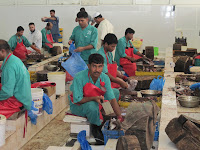
From the Kempinski we drove along the Ajman Corniche (beach road) but the public beaches aren't very well maintained and didn't appear to have many facilities. After a few kilometres the beach facilities suddenly drastically improved and we realised we had crossed the 'border' into Sharjah so we turned back round to finish our exploration of Ajman. The port in Ajman is located just north of the Kempinski but it wasn't visible from the hotel's beach - in Abu Dhabi the Meridien and Beach Rotana hotels both lie on artificial beaches looking onto horrible construction sites and a power station. Past the port we came to the Fish Market with traditional dhows moored up outside and we decided to have a wander through. Outside, where all the waste is dumped, the stench was pretty ripe but once inside we really couldn't smell fish at all. There was an interesting fish cleaning area with about 40 men squatting on boxes, descaling and filleting fish on wooden blocks for customers. Descaling was done with a big knife rubbed vigorously back and forth over the fish - sending scales flying everywhere! We didn't see any refrigeration at all but presumed that most people were buying fish to eat that day so it would still be fresh.


The final stop on our tour was at Ajman City Centre to get an inexpensive lunch. Inexpensive...yes. Healthy and tasty...not really. There is only a fast food court in this City Centre, no Japengo or other shopping mall chain of real restaurants. Another example of the fact that there is not a lot of money in Ajman. With a choice of KFC, Hardees, McDonalds, Pizza Hut...I was really overwhelmed with the choice! Even the non-burger joints were only selling pre-made food that was being kept semi-warm in chafing dishes. I went for the best of a bad bunch and ordered from SalaThai - cold beef in oyster sauce, lukewam rice and tepid vegetables. Strangely enough I won't be rushing back for more. In terms of shops, the mall is very small with about a quarter of it taken up by Carrefour and the rest containing the usual shops you have in Dubai.

Ajman wasn't a wasted journey since we were able to see that we haven't been missing anything all these years. I would still be interested to go to the museum one day and will certainly plan a weekend to the Kempinski at some point since it's far enough away to feel that you've really got out of Dubai and yet it isn't a long drive at all. Their restaurants looked good on paper (Indian, Chinese and a sports bar with surf 'n' turf type food) and they have a bar with a 3-lane bowling alley, pool tables and table football. Since there didn't appear to be anything else happening in Ajman, it's a good job they offer some entertainment. My tip: go to the Kempinski for the weekend, visit the museum which is 5 minutes away and stop off at the fish market which is 10 minutes away. Short and sweet.